

Most people don’t notice one-sided hearing loss right away. The good ear covers for the weaker one, so you adjust without really deciding to. You angle your head toward the speaker, turn the TV up a few notches, or ask someone to repeat what they said.
Whatever the reason, there is a cause behind it. Sometimes it’s temporary, like earwax or an ear infection. Sometimes it involves the inner ear or the hearing nerve. How your hearing feels won’t tell you which one it is, so the only reliable way to find out is a proper hearing assessment.
“Hearing loss in one ear can be easy to overlook, especially when the other ear seems to hear normally. A hearing assessment helps identify the cause and understand whether any treatment or hearing support is needed.”
— Rama Vaidyanathan, Audiologist in Chembur

What Causes Hearing Loss in One Ear?
Several things can weaken hearing on one side. What’s behind it often depends on how it started, whether gradually or all at once, and on what else you’re experiencing, such as ringing, dizziness, pain or a feeling of fullness in the ear.
- Earwax Buildup
Wax that collects and plugs the ear canal makes sounds seem dull and faint. Once the blockage is removed safely, hearing usually comes back. - Ear Infection
An infection, or fluid trapped behind the eardrum, changes how sound travels through the ear. Alongside muffled hearing, you may have pain, pressure, discharge or a clogged feeling. - Exposure to Loud Noise
One extremely loud event, such as an explosion or a sudden blast of music, can injure the delicate structures inside the ear. Years of loud headphones, machinery or music can do the same thing more slowly. - Inner Ear Problems
Problems in the inner ear can sometimes reduce hearing on one side. Ringing, dizziness or balance changes may come with it. - Sudden Sensorineural Hearing Loss
Occasionally, hearing drops in one ear over a few hours or a couple of days. Many people feel blocked or hear ringing and put it down to wax or a cold.
This one shouldn’t be left to see if it passes. Some causes of sudden hearing loss need treatment as early as possible, so see a doctor promptly.
Symptoms of Hearing Loss in One Ear
Hearing loss in one ear doesn’t always mean total silence on that side. Often the changes are slight, and you only notice them during everyday conversations.
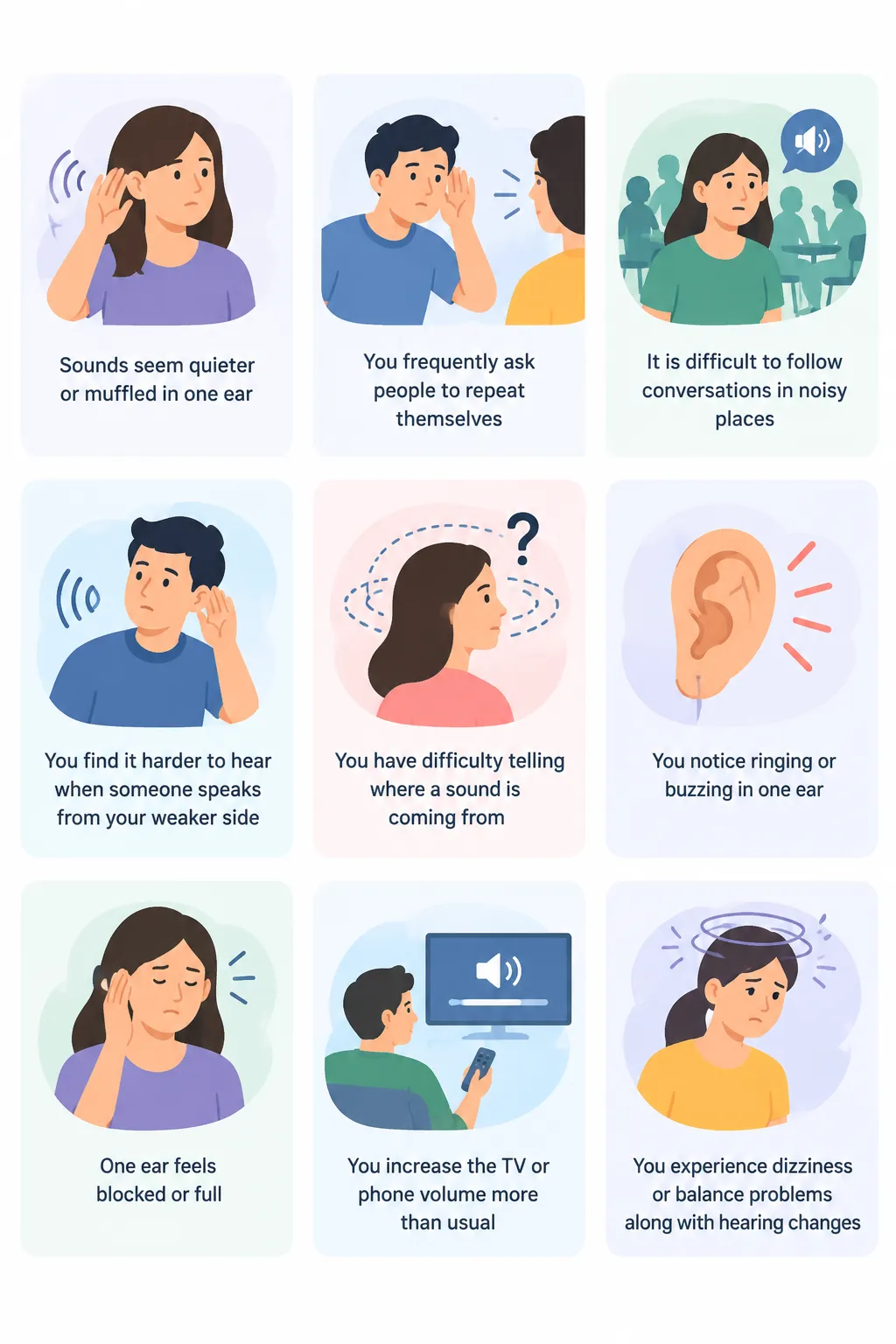
Often the first sign is just a sense that one ear isn’t hearing quite like the other.
If the change comes on suddenly, don’t hold out hoping it will pass. Have it checked promptly.
How Is Hearing Loss in One Ear Diagnosed?
Diagnosis starts with two questions: how much has your hearing changed, and why?
An audiologist will usually begin by talking with you. They’ll ask what you’ve noticed, when it started, and whether you’ve had ear infections, noise exposure or any other symptoms.
- Ear Examination
The ear canal and eardrum are examined for wax buildup, infection or any other visible problem. - Hearing Test
A hearing test shows how well each ear responds to sounds at different pitches. Pure tone audiometry is the standard method for establishing the type and severity of hearing loss. It’s particularly useful when you suspect just one ear, because your two ears can be compared directly.
If you’d like to know more before booking, you can read about hearing tests and Pure Tone Audiometry.
- Other Tests
Depending on your symptoms and results, an ENT specialist or audiologist may suggest further tests to find the cause.
Confirming that hearing loss exists is only part of the job. The rest is understanding why it’s happening and deciding how to manage it.
Treatment for Hearing Loss in One Ear
The right treatment depends on the cause, type and severity of the hearing loss, so it differs from person to person.
- Treating Earwax or Ear Infections
If the problem is a blockage, an infection or fluid in the ear, treating that underlying issue can often improve hearing. - Treatment for Sudden Hearing Loss
Sudden hearing loss in one ear needs prompt medical assessment. A hearing loss assessment can identify the type and degree of hearing loss and guide treatment. - Hearing Aids
When hearing loss is permanent and amplification would help, a hearing aid may be recommended. Which device suits you depends on how much hearing you’ve lost, your lifestyle, your comfort and how easy the device is to manage day to day. A hearing aid trial lets you try different options in everyday situations before you decide. - Other Hearing Solutions
Not all one-sided hearing loss is managed the same way. After your assessment, an audiologist or ENT specialist can explain which options may suit you.
Whatever you end up choosing, get the cause checked first. Picking a solution based on symptoms alone is a poor starting point.
Noticing a Difference in One Ear?
A hearing assessment can help you understand what’s causing the change and what to do next.
When Should You Get a Hearing Test?

There’s no need to wait until hearing becomes a real struggle. Consider an assessment if:
- One ear consistently sounds weaker than the other
- You have trouble following conversations in noisy places
- You often ask people to repeat themselves
- You have persistent ringing in one ear
- Sounds seem muffled or unclear
- You find it hard to hear someone speaking from one side
- You’ve noticed a gradual change in your hearing
- You’ve had repeated ear infections or significant noise exposure
If your hearing drops suddenly in one ear, seek medical attention promptly. Don’t wait for it to improve on its own.
A hearing test gives you a clearer picture of each ear and a sensible next step.
Don't Ignore Changes in One Ear
The cause might be as simple as earwax. It might also be something that needs medical attention. Either way, a change in one ear is worth having checked rather than getting used to.
The sooner you know what’s behind it, the easier it is to talk through next steps with an audiologist or ENT specialist.
Think One Ear Isn’t Hearing Like It Used To?
Don’t ignore the difference. Get your hearing checked and find out what may be affecting it.